Saturday, December 12, 2009

CRANE MIGRATION:
Was outside this afternoon, catching up on late winter chores and I heard a sound like a raspy woodpecker. Looked up and saw a long thin line of migrating birds. they were cranes, estimated about 100 to 150 of them, ran inside and found my camera, got one picture as they fly fast. Assume them to be Sandhills heading for their winter home in Texas. they were flying south-west. Some research indicates , they have an anatomical peculiarity, the windpipe is long (about 5 ft.) and is coiled within the hollowed keel of the breast bone somewhat like a french horn. Thus allowing for the loud long distant calls. Note the broad view and the closeup view, cranes fly with neck outstretched.


Wednesday, September 2, 2009


T.C.Steele State Historic Site (Indiana).......Took a day trip to Nashville ,IN yesterday and visited this historic site. A true pleasure!!!. Steele bought this 211 acres in 1907, to be used as his homesite as well as his artist studio. Steele a leading Indiana painter ,both portait and Impressionist ,made many visits to the Indiana University campus. Photos .... View of yard in front of home .. Autumn Wisteria bloom on an arbor

Saturday, August 29, 2009


COPPERHEAD CREEK GEODE -KY....Found this geode on a friends property near Berea Kentucky. This one has a reddish cast, which may contain Ferrous compounds. Geodes are voids in sedimentary rock,that are filled with mineral laden ground water,after many years, form either crystal or solid interiors. i.e A small cave.


WOODLAND SUNFLOWER....I HOPE ???. This is one of my favorite flowers to photograph in August and September. Very common along woods and small clearings ,thus providing a high contrast setting for photos. Never knew what it was called ,except by the name "Those tall yellow flowers are blooming again". Weird!!!!!!!!


CECROPIA MOTH LARVA......The larva feeds on a variety of trees and shrubs but mainly on cherry,plum,elderberry,apple,box elder and willow. Found this one near my flowering cherry. The legs or feet reminds me of miniature elephants hoofs.


TRANSFORMATION PROCESS...... Found this larva attached to a sign post in my yard. Thought it was a branch from the walnut tree,but upon closer examination it was a worm doing transformation. Amazing !!!!!

Saturday, July 25, 2009


ODD COUPLE........It's unusual to see a buck and doe together this time of year. They are at the salt area every day and seem to be traveling together. Are they last years twin fawns ? Sometimes I see spike bucks and small does together,but this guy has quite a nice rack. Again doe is thinner than usual ,buck seems to be in better shape.


FIRST FAWN of season..... This the first fawn of the season that has visited my salt area.By now the remote camera should have picked up many young. The mother is in very poor shape. Don't understand with the lush foliage why some deer are so thin. Not much corn or soybeans in the immediate area. Note the extreme long face of mother and fawn.

Saturday, July 18, 2009


Lunch for Squirrel....Never thought of grey squirrels eating anything but nuts and my bird seed, but this one likes mushrooms. I shoot a lot of what I call common wildlife pics, but this one rates near the top!!!!!!!. Cute little guy or girl ? Data...f3.3 at 1/125 sec. ISO 160 ,Exposure bias +0.3 step , 648 mm (35mm focal length)

Wednesday, July 15, 2009


WHITETAIL BUCK & DOE......Have not seen any large bucks this year,however this am.saw this big boy at the salt block. Got my camera and started out on the upper deck , just as I opened the sliding door,he was gone like a shot. This is about 125 yards. Pic shows the size difference between avg. doe and the buck,keep in mind that he was standing about 10 inches deep into the salt pit. O'yes the remote camera recorded him.

Wednesday, June 17, 2009

SWALLOWTAIL BUTTERFLY.......

FOUND THIS ONE on my Daisy patch. Seemed to be drying out. Coloration on the wings appears to be bluish- green rather than white. Lucky timing. Did not stay long...


Wednesday, June 10, 2009


Moth or Butterfly ? Was walking through my meadow and noticed this insect extracting nectar from this small white flower. Have observed a lot of butterflies, but this one was different, looked like a large colored fly. About 3/4 to 1 inch in size. If anyone knows what this is ,let me know. Thanks

Wednesday, June 3, 2009


Second year buck...We seem to have more bucks visiting ,our salt block ,this year than before . Also they are very thin for this time of year.The natural habitat is being rapidly reduced by housing and less crop production ,that limits food supply. We still have several hundred acres , natural hill-valley areas available, but a hundred acres have disappeared in the last 5-7years. It appears to me that the more bucks born, is natures way of ,over time, limit deer population. Since I use a game camera to monitor my salt block, it will be interesting to see how the population unfolds,over the next few years. My game camera yields approx. 50 to 70 photos/day


Brown Thrashers....Have had a pair around our meadow for several years,but I have not seen them as close together as this photo. Family Minidae....often called "mimic thrushes", excellent singers,strong legs and longer tails. Sexes look alike, member of the Mockingbird family. Notice the tail positions, guess you could draw a lot of conclusions from the attitude. Gorgeous birds !!!!!


Blue jays at tree feeder...Even though these appear to be a pair, their is still feeding status. Both tried to eat at the same time, but Mr. Mean Guy had to eat first, or is it the other way around? Waited about 1.5 hours to get this shot. Data:f/3.3 at 1/160 sec, ISO 160, shutter priority, 35mm focal length..648


Macro of Wild Turkey wing feather......Thinking about the little turkey poults, that are about the size of half a tennis ball and just as fuzzy,within one growing season, produce a structure that is able to lift them off the ground, is amazing!!!!! Sometimes during the summer, I find feathers in our meadow and stick them in the brim of my straw hat. In the fall I will have 8 to 10 various species of bird feathers in my hat, the old timers used to say," Another feather in my hat". Don't know orgin of this saying. Anyway, nature is most interesting!!!!! Approx. 5X macro

Thursday, May 14, 2009


Blue jay at feeder.....This time of year the blue jays are crazy feeding their young, going from daylight to dark. It appears we have 3 pair nesting close to my feeder area. During this time of the year , they tend to very quiet,also somewhat slimmer. Having kids is tough work.

Wednesday, May 13, 2009


Ordovician fossils from Little Jamison creek. In the spring , after the winter freezing and thawing, I like to spend time, in the creeks on our property,looking for fresh fossils, that has just been washed out, by spring rains. Several million years ago,this area was covered with shallow seas,which contained forms of life. This life ,through normal process, at least ,the more solid parts , was buried in the sea floor,after they died,an was preserved and became fossilized. REF....Geology/ A survey of earth science by E.W. Spencer

Thursday, April 16, 2009


MACRO..... Sycamore Seeds..... Interesting to look inside the round spiked fruit clusters of dried sycamore. Hair seem to be spring loaded to eject seeds from the fruit balls. Hairs are then used for the distribution of seeds ,on air currents. At least, those are my thoughts!!!! . These seeds are approx. 10 mm. in length.


Macro....Small blooming plant.... Was walking around my yard today, noticed this very small plant. I got down on my knees to observe it,an for some reason was amazed at how delicate it was. Most of the time ,I like most people, would have just walked over it or on it. Noticed several in this area, so I gently lifted it and the roots can out of the ground all in one piece. Flower is less than 1/8 inch in diameter, note several bud balls to the right. Don't know what the plant is,but I guess that doesn't really matter, it's NATURE at its best.


Macro graph ...Weeping Norway Spruce seeds. (P. abies ,"Pendula") A friend gave me these seeds several years ago,just getting around to try to start them. Sometimes I get tired of regular photos, done a lot of macro work in my first technical job,about 47 years ago.

Wednesday, March 25, 2009


Digital Camera Preset Modes.....Never even looked at presets on any camera; they were for amateurs. Well, I could be wrong!!!!! Was having some trouble ,stopping motion at ISO 800,even with the shake control on. So as a last resort get out the manual. Found a HIGH SENS. preset, ISO 3200 ,good for 4x6 pic size. This deer was looking in the window at me,so I took a couple of shots. Whereas the image lacks sharpness and shows pixelation, I found it interesting (kind of art-like) especially, inside the ears. Picked up veins above the eyes and the buttons on the head. f8.0 at 1/1600 sec, 432mm (35mm focal length) . READ those Manuals !!!!!!!

WHITETAIL DEER in freshly mowed meadow.....Every year I try to mow off my meadow in very early spring. Last year I cut a portion of it in October, leaving a small circle of it standing over the winter. Last week I mowed the small circle patch. The natural grasses had caught a lot of leaves, that created warmth, thus new green tender shots started to grow. The deer don't miss much.


Monday, February 23, 2009


Photo-Study of Wild (hen) Turkey head/neck . Are they a handsome bird? More on this subject latter,

NEW THOUGHTS.....See turkeys every day, sometimes when alarmed they fly immediately,sometimes they run. What triggers the thought pattern or is it instincts? They seem to be very good at running and seem to resemble the dinosaur-birds, neck extended and very good balance , for an out of balanced body. What about the non-feathered heads,like the VULTURES, rather small head to control such a large body, Why??? . Appears to be a very smart,at times ,has excellent memory at least to remember where to find food, had a feeding stump,for the turkeys, dug out the stump and they returned to that precise spot for 3 years. On Nov. 6, 2008 blog,I was feeding turkeys by hand, these guys disappeared,until last week , when I saw one standing in my meadow, went outside to throw away some table scraps,with a similar feeding hand motion,and the tom came running. Went up on the upper deck,so he could see me better and made similar hand motions ( no food ) he also came running. Assume he recognized hand motion with food,processing information or just instincts ? I don't have any idea!!!!!

still doing research.

FOX SPARROW feeding in a snow storm. Have seen these birds for several winters at my feeders. RANGE...Alaska and Canada ,winters to the US.

LOOKING EYE TO EYE with a WILD TURKEY. Beginning to use my blind again ,to get some close-up photos , of these guys.

RUFOUS-SIDED TOWHEE waits it's turn at the feeders this icy cold day. Have several breeding pair.


HUNGRY WHITETAIL DEER in ice and snow. I know, they destroy a lot of shrubs and yard plants this time of year,but aren't they beautiful.

Wednesday, February 4, 2009


Fox Sparrow,Ice and Reflections.... Looked out the window this icy morning and saw a ball of feathers perched on the branch. At first I just start taking photos as fast as the camera will shot,then after documentation, I start to look at composition . Shooting out of a window the movement of the camera on the X and Y axis was limited. Noticed the ice covered meadow with it's specular highlights,moving the camera to lower corner of the window frame, positioned the highlights just right of the bird. Generally like to use the thirds rule,thus divide the pic in thirds and place interests in these spots. Photo was flat, but a little work in Photoshop seemed to help. Upon close examination the Fox Sparrow has it's eyes closed.

Tuesday, January 13, 2009


Southeastern Indiana Coyote....The middle of April 2007 ,photographed this good looking coyote going through my meadow. Don't see them very often, usually they are very ragged and skinny. Coyotes range through-out the US,Canada and Mexico,and have accumulated to human civilization much better than it's grey wolf cousin. Typical packs consist of 6 closely related adults, yearlings and young. Coyotes reach their full growth in one year, whereas wolves reach full growth in the second year. Coyotes can dig their own burrows ,but usually take the burrows of groundhogs,at least in our area. Territorial ranges can be up to 10 miles around the den. Reports indicate 50 to 70% of pups do not attain adulthood. Reference.......Wikipedia

Sunday, January 11, 2009


Male turkey position in a " gobble". In the spring ,during the mating season ,male wild turkeys respond to a quick,loud noise with a gobble. Some times when a thunder storm is approaching,I hear turkeys responding to the sound of thunder. My great granddaughter's voice , also receives a response. Photographed this guy in the middle of a gobble. Spring of 2008.

Wednesday, December 31, 2008


MOURNING DOVES bring back memories. Was born and raised on a hilly farm in southern Indiana, life was good, but harsh. Remember setting on the front porch with my Grandmother , after supper, she said "Listen to the Rain crows" will rain soon !!. Our heritage is German, don't know if this a German name for doves. Back then, some 70 years ago, it was a rarity to see doves. As I write this blog ,there is 10 feeding outside my window. Thought for the day....Have a good 2009 and may all people find peace.

Tuesday, December 30, 2008


Red Fox on early morning hunt....Once or twice a year I see a quick glimpse of what I think is a fox. The remote camera caught this one several times in the last 2 weeks. Usually at the edge of the pic or out of flash range, resulting in very low quality. So ,why not bait in the right area, whatever it takes to get the pic.

Red Squirrel in Brush....Looking out of the window ,I saw flashes of reddish-brown color moving in a brushy area. Thought a red-tailed hawk was chasing song birds, however these 2 squirrels was chasing each other up and down the limbs. Playing !!!,well maybe its just getting spring.

Monday, December 29, 2008


BLUE JAYS in an ice storm. Interesting to look at the feather structure under unusually conditions. Note the head-on shot of the 1st. pic exhibits a different feather pattern than usual. Maybe to retain warmth.


Images from remote camera in shade garden. Wild turkeys scratch for food after a dusting of snow. Deer forages for food during an early morning morning snowstorm. Flash highlites the snow flakes.

SHADE GARDENS attracts a lot of wildlife. Started to clean out about 3/4 acre, of a southern exposure hillside,several years ago to create a shade garden. My idea was to plant shade-loving flowering plants, however the deer started to use it for a food plot. So I just planted it in grasses and mow it every month. I left 3- 50 foot circles of original brush as animal and bird habitat. Recently the wild turkeys seem to like this area . Have mounted the wild game camera in this area for the winter. The area contains a lot of small trees, white ash, white oak, red oak popular ,elm ,black walnut,red cedar ,red bud ,native flowering dogwood ,persimmon ,catalpa and black cherry. This blend give a lot texture and color thru the spring and fall. Note the black camera on the foreground tree.

Wednesday, November 12, 2008

Small Button Buck finds its way in the IR beam of my game field camera. Have the camera set up on a old hillside logging trail that deer ,other animals and turkeys use. It is difficult to let a camera do what the program wants to do,especially to a person who wants to control everything. Photo was taken at F2.8 ,shutter speed 1/27 sec. note the buck was moving and a motion blurr is present,however if I was present
the buck would have sensed something invasive. So I guess everything has a trade-off.

Monday, November 10, 2008


White-breasted Nuthatch is a small song bird of the nuthatch/creeper family. It is a stocky bird, with a large head, short tail, powerful bill and strong feet. Seeds form a substantial part of its winter diet, thus it is a frequent visitor to my feeder. Nuthatches talk a lot,a sort of grunting chatter. I photograph from a blind about 7 feet away ,and even with my bad hearing I can still hear the chatter. Has a tendency to go down a tree head first.

Saturday, November 8, 2008


Red-bellied Woodpecker ready to leave it's perch. A medium sized woodpecker of the Picidae family. We have a nesting pair,has raised an offspring this year. Its name is somewhat misleading, as the most prominent red part of its plumage is on its head, with a tinge of red on its belly. This a male (with red from beak to the nape) , they are very noisy and have a tendency to take feed from the feeder and store it in the bark crevices of near by trees. Many hours can be spent watch ing this bird.

Thursday, November 6, 2008


Coyote working 3rd shift....Have not seen a coyote in our meadow for 2 yrs. Just purchased a wild game camera ,as an extension to my wildlife photography. The game cameras are usually strapped to a tree in a remote area to monitor animal or wildlife behavior.The IR beam senses motion and /or body temperature that triggers the shutter,thus 7/24 observation. This photo was taken at 3:53 am; 10 minutes before, a raccoon was recorded in the same place. 10-06-2008


Feeding Wild Tom Turkeys .... Several months ago ,I noticed 5 male turkeys were hanging around my meadow area. One day I had some stale bread, so I took it out side for wildlife feed, the 5 turkeys were hanging around ,so I sailed the bread toward them,they came running to eat it. Next I put shelled corn in a plastic bucket, shook it around to make noise, an they came running.Recently I saw a flock of turkeys in the same area ,got my corn and plastic bucket ,shook it and they flew away,WRONG TURKEYS. Pics show how close they get and size of them,note the beards.( feathers protruding from the middle of chest)

Wednesday, October 29, 2008


NORTHERN CARDINAL with bad hair day. Was photographing song birds today, when this cardinal came by to have a snack, the wind was gusting to 18-20mph,turning his head ,the wind caught his top-knot ,standing it straight up. For the next hour,I did not see this happen again,thus it must be uncomfortable to them. Anyway, I find this interesting.

Saturday, October 25, 2008


Canada Geese on Byrd's Lake,Tenn. Photographing Canada Geese is an easy and common subject. They are quite tame in most areas and are looking for easy food supply. When I was a kid (a long time ago) the only Canada geese we saw was the migration "V" and the honking going over head in the fall and spring. While at Bryd's lake the foliage was showing a lot oranges and reds,I noticed the reflections in the water,so I tried to call the geese into the reflected area,and it worked.However, the secondary gooses head was hid behind the foregound goose,at the last moment the secondary goose turned it's head and this composition occured. Maybe a combination of luck and talent

Friday, October 24, 2008

Bridge /Dam at Cumberland Mountain State Park.

A project of the Company 3464 of the Civilian Conservation Corp (CCC) built from 1935 to 1938. The dam created Byrd's Lake as the parks central focus. The 347-foot long dam proved to be the largest masonry structure constructed by the CCC in the entire nation. Near Crossville,Tenn

Annual visit to FAIRFIELD GLADE ,Tenn.

Photo of one of many lakes on the property. We go down every year in the fall, just to get away. The GLADE is on a large plateau in the Cumberland Mountains , a place were every thing slows down.Nobody is in a hurry; near Crossville,Tenn.

Wednesday, October 22, 2008


TRUMPETER SWAN at Kellogg Bird Sanctuary .Similar to the Whistling Swan, America's common native swan. Wing spread 6 to 7 feet. Photo shows the gracefulness of these large birds. This bird kept putting its bill in the water ,scooping up something,aquatic material or maybe it was thirsty. Note the drops of water coming off the bill.


RED -TAILED Hawk photographed at Kellogg. Red tail colour show when the hawk is soaring. Range: Alaska,Canada,to Panama . Habitat:Open country, woodlands, paririe groves, mountains, plains. This bird was caged,the wire was digitally removed.

GREAT HORNED OWLS at Kellogg Bird Sanctuary. A large owl with ear tufts or horns. I assume this pair to be parent and offspring. Several forms of this owl ,this is typical, also a subarctic (lighter colored) form. Note the yellow eyes.
BARRED OWL photographed at Kellogg Bird Sanctuary . Only owl to have brown eyes except for the Barn Owl. Range ;Canada to Honduras Habitat ; Woodlands,wooded river bottoms, wooded swamps.

Thursday, October 2, 2008


Mature BLACK SWANS at Kellogg Bird Sanctuary. Black swans are mostly black feathered with a line of white flight feathers . Cobs (males) are larger than pens( females) with a longer and straighter bill. The bill is bright red, with a pale bar and tip.The neck is long and curves in an "S". Wingspan ; 5 to 6.5 ft. ;Weight 8 to 20 lbs.;Length 40 to 55 inches. Native of Australia. First photo ; swan on land really looks awkward but a beautiful bird. Second photo, swan on water in an aggressive position. This bird charged us, standing on a small walkway bridge for about 20 minutes. It would bite our shoe toes, time after time,swimming away then returning at full swimming speed. Note the neck feathers standing on end.


BLACK SWAN CYGNETS at Kellogg Bird Sanctuary. Generally, black swans nest in the wetter winter months(Feb. to Sept.) native to Australia and adjacent coastal islands. A clutch contains 4to8 greenish-white eggs ,incubated for about 35 to40 days. After hatching, the cygnets are tended to by the parents for about 6 months ,until fledging.....REF..Wikipedia..Black Swan

Wednesday, October 1, 2008


Tundra Swan (Bewick's race) photographed at Kellogg Sanctuary in Michigan. Found it interesting as to the structure of the bill. Must be a very interesting reason for all the contours and ridges.

Monday, September 22, 2008


Kellogg Bird Sanctuary a part of the Kellogg Biological Station (given to Michigan State University 1951) is one of my favorite places to observe and photograph birds. Photo shows Wintergreen Lake (40 acres and 20 feet deep) and some of its residents,most waterfowl is free to come and go. Check it out at birdsanctury@kbs.msu.edu

Tuesday, September 9, 2008


Miniature Wood Duck carving by the author. Many years ago,I did a lot of wood carving ,last year I planned to do a set of 12 duck species carvings in miniature. (3 to 5 inches long ). Somehow I lost interest ,but since the winter months are approaching ,hopefully the interest will return. Posting of this practice piece should be encouragement,well,at least the colours all seem to match.


Quote for the day.....All truths are easy to understand once they are discovered ; the point is to discover them .-- Galileo Galilei

Saturday, September 6, 2008


Brilliant autumn colors ,are due to the presence of accessory leaf pigments that normally assist the plant in photosynthesis by capturing specific wavelengths of sunlight. These pigments,called carotenoids, become visible when the leaf dies in the fall or stops producing chlorophyll (i.e. green color ). Photo shows 2 stages of coloration,this year the Popular tree seems to color much earlier than usual. Early or severe winter, maybe a lack of moisture ???.


Quote for the day.....All good things are wild, and free.....Henry David Thoreau

Friday, September 5, 2008


Blue mist bluebeard shrub is a breath of fresh air when the mid-summer garden starts to look tired. This lightly fragrant plant, produces flowers to frost. Very hot summers and very cold winters are not good for longevity,however these plants are easily started from cuttings. The photo is my first year planting. Quote for the day.....Age is an issue of mind over matter. If you don't mind,it doesn't matter----- Mark Twain

Thursday, August 28, 2008


Red-crowned Crane...Cincinnati Zoo. The red-crowned crane symbolizes good luck and long life in Asian culture, yet it is the second rarest crane in the world .It's critical habitat is threaten by industrialization and population increases.( IUCN -Endangered ). Life span ....25+ yrs....Habitat...wetlands...Wingspan..7 to 8 ft....Height..5 ft...Weight... !5 to 22 lbs. Diet.. aquatic animals and plants...Mate for life. Quote for Day...A thankful heart is not only the greatest virtue, but the parent of all other virtues.--Cicero,from De Amicitia

Friday, August 22, 2008


Macro-photograph of grass seed with insect eggs attached. Also find small insect down from the eggs.


Rose of Sharon petal,showing structure and texture. Quote for the day......Minds, like parachutes, only function when they are open--Anonymous

Wednesday, August 20, 2008

Update on Nightbooming Cereus....Just aborted it's bud.....Bummmer!!!!! Quote for the day.....You can't depend on your judgment when your imagination is out of focus--Mark Twain

Saturday, August 16, 2008


Nightblooming cereus bud is starting to develop. Had this plant for about 30 years, bloomed several times,last time 7 years ago. Cereus is a genius of plants of Cactus family,Southwestern U.S ,Mexico and South America .Leaves are thick and rubbery,heavy veined. The veins, at edge of leaf, produces new growth,sometimes it produces a flower bud.

Friday, August 15, 2008


SURPRISE LILIES are a welcome surprise in August, at least in southeastern Indiana. As a photographer, thing are pretty bleak this time of year. So as I look at the beautiful lilies ,photographing seems to be very simple. Somehow, at least, to my eye- brain function things look OK, through the view finder, but as on the computer monitor an extremely flat two dimensional photo exists. Digital photography is known for it loss of depth of field ( at least in the simpler cameras that I use) ,so shadowing becomes increasingly important. I like to include a small amount of foliage in the photo as reference and texture ,but these beauties have none, this time of year. Since they grow in a rotary pattern, have slim lines ,and are usually intertwined , it is difficult to show structural, petal beauty. This is my attempt to show its beauty.

Wednesday, August 13, 2008


Cloud Formation coming from North to South, cold front moving in,good sun bounce at sunset. August 07, 2008 at 8:39pm. f4.0 at 1/160sec., Iso 100 ;35mm Focal length 144. Love to watch clouds!!!!


GOLDENRAIN TREE is a species of KOEREUTENIA native to eastern Asia,in China and Korea. My tree has survived cicadas, whitetail fawns and its last tragedy was a high wind that split it in half.(taped it back together with duct tape) and it bloomed for the first time this year. The photo shows the fruits that form after the yellow flowers. P.S. 73 years ago today,in a thunder storm,in an old farm house, the author came into this world. Life is good.

Tuesday, August 5, 2008


Cockatoos have a much more restricted range than parrots,occurring naturally only in Australia and nearby islands. Have characteristic curved beak and a zygodactyl foot (two toes forward and two toes backward). This one, at the CINCINNATI Zoo, moved around on his tree perch like a clown, first ,using it's beak then it's feet. Like the way its looking at the camera. What's it thinking?????

Saturday, August 2, 2008


Steller's Sea Eagle...breeding range:Northeast Russia, winter range Korea,Japan and Alaska. It's favorite prey,the salmon has an extremely tough skin for which the eagle is equipped with a specialized hatchet-like beak. Weighing up to 20 lbs.;length 3.5 to 4.0 feet; wingspan 7.5 to 8.0 feet. Cincinnati Zoo,Cincinnati,Ohio

Thursday, July 31, 2008


Styan's Red Pandas is the first in a series of animal exchanges between the People's Republic of China and the Cincinnati Zoo. Red Pandas are classified as endangered. Red Pandas eats mostly bamboo, they are excellent climbers and forage largely in trees. Red Pandas are hunted illegally in Asia for their fur. ( Ref.....Wikipeda)


Sumatran Rhinoceros feeding calf (born April 2007) at the Cincinnati Zoo, both covered with mud.The world's most endangered rhino,it suffers from deforestation and poaching for its horn. In 2001,the Cincinnati Zoo breed and had born a Sumatran Rhino calf in captivity,the first in 100 years. Calf is said to weigh over 400 lbs.

Monday, July 28, 2008


This time of year , bucks seem to pair off and hang out together. Later they will compete for breeding status. Since I see bucks from year to year, have noticed that some of the 2nd and 3rd year buck have similar rack shapes. Also since we are in a limited hunting area,I saw these two, last year ,doing similar things, however the racks have more points this year. 7-23-2008

Sunday, July 27, 2008


Zebra Swallowtail.....an eastern species more common in the South, varies in marking and size. Spring forms are smallest; later broods larger and longer tails. Larva feeds on pawpaw.( Ref..Butterflies and Moths..Golden nature series 1964) Saw this one drying under a Eastern Red Cedar.

Saturday, July 26, 2008


When you see a flash of color, as a hummingbird zooms past it seems to be a color flash from the human eyes. As I looked at this photo,some dark colors but some very vivid,I had forgotten the reason for this, so I did some research.Most birds attribute their color to pigmentation,but the hummingbird is said to have special cells within the top layer of the feathers. These cells diffract the light into different wavelengths(i.e. producing different colors),depending on the viewing angle, only specific colors,at that angle, are seen by the human eye.Guess I have a lot more questions as to why this specie of bird was made this way? Nature is fascinating!!!!!!

Sunday, July 20, 2008


It has been said "A picture is worth a thousand words", this is just summertime beauty.

Like to photograph a variety of subjects,the Bullfrog was well hidden and hard to see in the water. The light colored butterfly in geranium flower also is partial hidden. Don't know specie of butterfly,we used to call them Cabbage butterflies ,back on the farm.

Went to Oliver Winery, Bloomington, In. not only do they have excellant wine but the grounds and landscaping is wonderful. Hugh waterfalls and flowering plants.

Wednesday, July 9, 2008


Portrait of a Whitetail fawn....don't need to say much more.

Well ,its the time of the year when the does bring the fawns out in the open. Have seen these twins for about 3-4 weeks ,they were running around in my shade garden area. Today mom introduced them to me( maybe I've been watching the bear man in Alaska to much) however , the doe keep herself partially behind the tree(top pic) an in the (2nd pic) let the fawns come within 30 feet of me,she was watching me all the while and did not give the danger snort. Maybe whitetail mothers are proud too....Nonsense...?????

Sunday, July 6, 2008

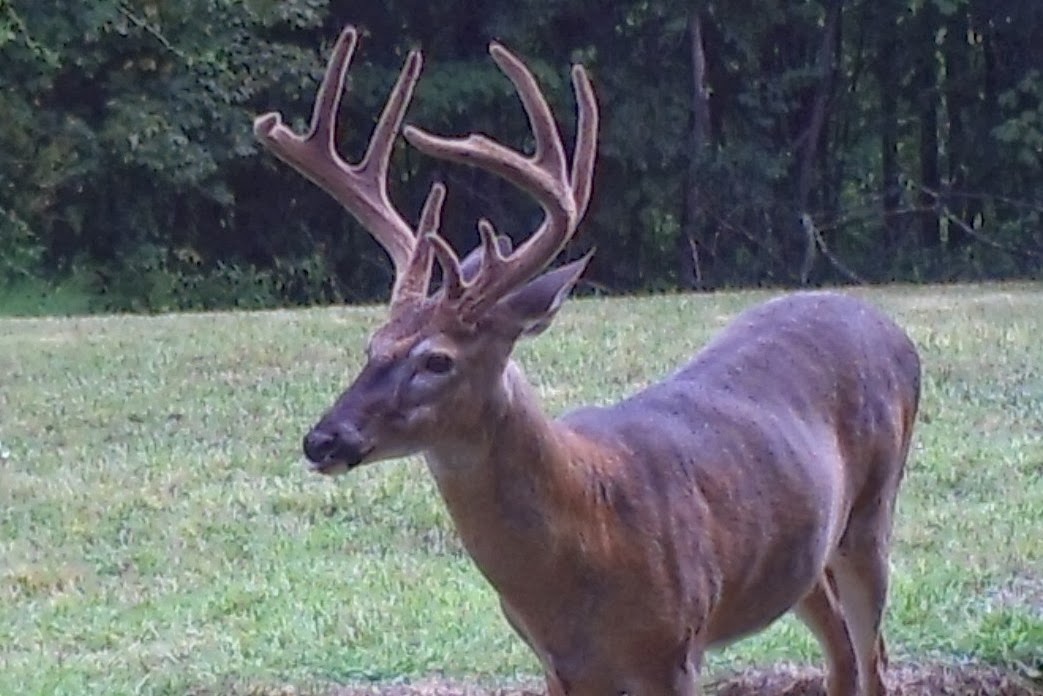
Nice little whitetail buck, with antler develoment(in velvet). Note scar on side from last years battles.


A bee finds lunch on this beautiful flower I bought this year.( Prairie Sun Rudbeckia)


Small female Ruby-Throated Hummingbird with a pleasant look is intrested in the camera
Carving in the TULUM MAYA RUINS, at the Facade of the TEMPLE of FRESCOES. Image of the Descending God ,feet up ,head down, guide said it indicates birth.

Iguana standing guard at the MAYA RUINS (TULUM) at the lookout post. Fruit on plant at the RUINS

Tuesday, June 24, 2008

Portrait of the Common Grackle (Quiscalus quiscula) A large iridescent blackbird with a long wedge- shaped tail.Also a "Bronze" Grackle and a "Purple" Grackle , they are considered separate species

Male Red-Bellied woodpecker has the chore of feeding the offspring. Baby woodpeckers are nasty tempered and tries to attack parents. Wants food now and much of it. Note the precision it which the feeding is done, tilting of the head and not getting stabbed with the beak.
The square hole in the wall,Tulum Maya Ruins, served as an aperture for the sun to determine the two equinox.Within the precincts compound,was a marker, that when the sun's rays shown through the hole, aligned with a cross on the marker, it was equal hours of day and nights (equinox). Our Mayan guide indicated this occurred around 5:00 am, two times a year. * The Maya developed an original system of writing,with which they recorded astronomy,religion and history. The Maya also had a concept of zero. Civilization lasted 300BC to900AD. *Microsoft Encarta 99

Sunday, June 22, 2008


The Castle ,Tulum Maya Ruins ,rises the highest and the most spectacular structure of Tulum. Stone arches were rather common, within the inner precinct, as well as gateways through the outer walls. The building was constructed in various stages. re:Tulum,History,Art and Monuments,Monclem Ediciones S.A. de C. V.


Blooming plants within the Tulum Maya Ruins, assuming these are plants native to the Tulum city. Orange flower photo , shows the stone work laid up by the Mayas.White flower is native to the Ruins (according to our guide ),who was of Mayan descent.

Thursday, June 19, 2008


Visited TULUM maya ruins in Quintana Ro, Mexico and while resting under a tree I noticed this bird catching insects ,then returning to a perch on bare limb. Have no idea name of the bird, however with the fuzzy head and catching insects could be some specie of a flycatcher. The IGUANA ran across in front of me an poised on the edge of the cliff near the sea. It was 3+ft. long. The iguana respond to a chirping sound that I made, turning its head in my direction. Assuming, by the dusty look ,its an arid living , not aquatic. Weather was hot,96F,(90% H)

Wednesday, June 18, 2008


Hotel Riu Yucatan,Playa del Carmen,Mexico.....Just got back from this paradise, granddaughter married here.. Good Luck to Zak & Denise . First photo, lobby area.....Second photo ..beach area Caribbean sea

Wednesday, June 11, 2008


Was watching two squirrels, one red(fox) and a grey in the rain. The red laid in the crouch of the tree,trying to stay as dry as possible whereas the grey was out in the open. Both covers their backs with the tail.


Whitetail deer instincts are amazing. They try to keep something between you and them. The branches of the old white cedar is not much cover ,but the bucks knew I was on the upper deck ,trying to photograph them.


Bought these Rhodadrenon plants from Musser Forests,about 25 years ago,they were about 3 inches tall. Last measurement they were a little above 18 feet. Have moved them many times to find right soil,planted in this old grove of sassafras trees.


Indiana whitetail deer tends to go thru a color change this time of year. The doe has a mottled look ,were as the bucks look a little smoother. Buck is in early velvet (antler development)


Wildflowers are starting to bloom here in Indiana. Don't know what the orange one is, but must have come from a packet of wildflower seed that did not come up last year. White one, I call this a Spring beauty, should have a pink tint to it. Have a large Maple tree that the ground is carpeted with these beauties.


Love to photography flowers. Iris and Flowering Quince. Like to play with the lights and darks. All natural lite.

s

Portrait of a gobbler. Like this picture because of the cross lighting. Shows the wattles and a lot of the blood flow, during excitement. Sometimes the feathers catch a lot of colour and puffing. Note the barred feathers are rather ragged from dragging on the ground.


Its time for the wild turkey mating ritual to begin. This year I have a portable blind so I can get closer to all the action. The two gobblers just strut around and show off for the hens,which I assume makes her choice. The first pic apparently is some kind of a face off. Have not seen any fighting,however the 2.5 inch spurs could do damage. The second pic shows gobblers closing in on the hen. She rejected both.

Tuesday, June 3, 2008


LARGE-FLOWERED TRILLIUM ....The most abundant of the trillium in the Smokies,also one of the most beautiful. Grows on wooded slopes from 1,000 to 3500 feet elevations. Blooms in April and May. Yellow center is the key to determining the species. image....4-07-2008


It is interesting to look around abandoned homesteads in the mountains. The primitive way of life and the hardships the settlers must have endured,is unbelievable. Yet, signs of unique knowledge is prevalent. Wild Geranium was found near the old home,flowers appear in April . Fairly common on wooded slopes up to 3500 feet. image .....4-07-2008


Both large and small streams in the Smokies have charm. The large stream( right) near the bottom of Roaring Fork motor trail has a lot of fall and is loud, showing power and harshness. The small stream was high on the Cove Hardwood Forest trail. Today the air was still , cool, and wet with rain from the previous day. The mountain was very quiet, I heard the trickling of water, looking around , saw the little runoff. As I sat down by it, I understood why people like the mountains, just something one can not explain.

Monday, June 2, 2008


Photos of the lower ( less rugged ) portion of trail above the Chimneys Picnic area.


Dutchman's -Breeches ( Fumitory family ) Nodding shaped flower with spurs at the top. Rather rare in the Smokies. I would not have seen this one; found after a seasoned wildflower person told me the location. When I left the mountain,there were 6 Nature photographers set up around it. Image.....4-07-2008


White Fringed Phacelia ( Waterleaf family) Only 3 to 5 inches tall. Looks like patches of snow. Very delicate ; Chimneys picnic area, Smoky Mountain National Park. Image 4-07-2008

Sunday, June 1, 2008


Photos taken in the Chimneys picnic area. The trout lily(left) the mottled leaves resembles a mountain trout and lure has it ,the Cherokee Indians regard the blooming of the flower a good time to fish for trout. Other photo,aYellow Trillium ,3 leaves,3 petals and3 sepals,lemon scented is a prominent spring flower in Smokies. Images........4-06-2008


First wildflower is a White Erect Trillium. Grows 8-10 inches tall,blooms in April and May.(Lily Family)

Wildflower on the right,is Rue Anemone part of the Buttercup family. These photos were taken on the Cove-Hardwood trail at Chimneys picnic area.


It's April , time for our annual trip to the Smokey mountains. We like to see the mountains wake up in the spring. Wildflowers are starting to bloom and the streams are running full from recent rains. New boulders have washed out and I like to figure out some of the geology. Closeup shows striations and a vein of minerals. ....image...4-06-2008

Wednesday, May 28, 2008


Moth orchid in bloom (Phalaenopis). Having an orchid collection provides much enjoyment. Second photo , macro of inside the bloom. Image 4.03-2008


Early arrival of Eastern Bluebirds at my nesting site.About a month early. Blue with rusty red breast and appears to be stoop shouldered went perched. Image 4-02-2008

Tufted Titmus at my feeding station. Seems likely to be a pair. Tufted Crest is erect,flanks are rusty orange color. Habitat : woodlands,shade trees,groves and feeders. Image 4-02-2008

Alligator in Ding Darling swamp ,Sanibel,Fl. The gator was just slowly swimming around in the mucky water. First time I have seen one here in 5 years. Image 2-05-2008

Tuesday, May 27, 2008


Three shore birds in late evening light. Every thing calm, foamy white waves. Image 2-15-2008
( click image to enlarge)

Flower growing in the gardens at THE BREAKERS, West Palm Beach. Don't know what it is ,but its beautiful. Image 2-11-2008

Went to polo match today,YLVISAKER CUP,International Polo Club near Wellington Fl. First time I watched polo, very interesting. Lucky shot of horse and rider. Feet and ball off the ground. Image 2-10-2008

Friday, May 23, 2008


Went to Sanibel today, love to visit the National wildlife Preserve . Couple shots of the Snowy Egrets,the first....hunting for food in the mud flats, the second...preening on his perch.Note the lacy feathers. Image 2-05-2008

Pelicans are most interesting. The flying ,sailing and diving. Always wanted to photograph one coming off the water.Wing spread around 6 feet. Image 2-04-2008


February at last,time to head south to visit family and friends.Love to walk on the beach an photograph shore birds. Like to watch how they interact with people. Today I watched a Willet fishing. First photo...catching.....second....getting ashore...third....eating. Image 2-04-2008

Thursday, May 22, 2008


It's the last of January ,the food supply for the wild turkeys is becoming hard to find. They come closer and closer to the house. However, at the least sound they become alert.

Zygocactus (Schlumbergers truncata) Zygocatus originated from the branches of trees in South America jungles, so reads the label. They bloom once a year ,hopefully at christmas time, ours was a little late as usual . The blooms were nice this year ,so the wait was o.k. I notice the viewing close-up resembled an odd looking bird.What do you think?

Wednesday, May 21, 2008

January 2008


Hunting season was now over and the little buck had survived. A cold snowy winter lies ahead. Maybe a little salty soil will help him feel better.